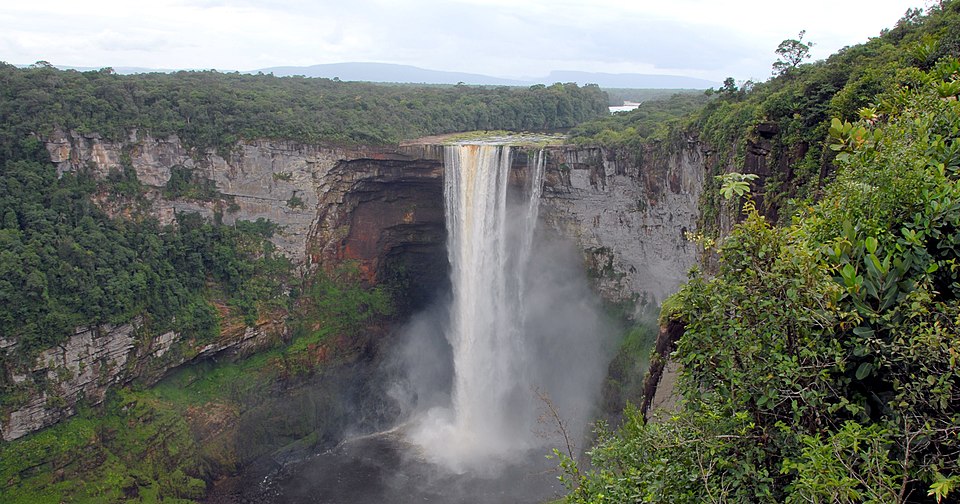
Photo: Kaieteur National Park · Bill Cameron · CC BY-SA 3.0
First-Timer Guide 🇬🇾Guyana: What to Know Before You Go
Destination Intel / Guyana
A typical first trip here runs about $800 to $1,075 per person for 7 days at a mid-range style, before flights. This is a rough estimate from PINYA regional pricing, not hand-reviewed yet, and not a live price. Real cost moves with your dates and exchange rates. Get a tailored number in the Budget Calculator, or have The Crown price your exact trip.
Culture, Food and Etiquette
- Pepperpot: Guyana's national dish, a dark, rich, slow-cooked meat stew (beef, pork, or oxtail) simmered in cassareep (a thick cassava-juice reduction with spices) and Scotch bonnet peppers; traditionally cooked continuously and kept warm for days, especially at Christmas
- Cook-Up Rice: One-pot rice cooked with coconut milk, pigeon peas or black-eyed peas, salted fish or meat, and spices, Guyana's Friday comfort food, prepared at the end of the week with whatever is in the kitchen
- Metemgee: A thick Afro-Guyanese stew of ground provisions (plantain, yuca, eddoe, cassava) simmered in coconut milk with dumplings and salted fish, a rich and filling ancestral comfort food
- Dhal Puri: Indo-Guyanese flatbread stuffed with ground split peas and cumin, served with curried vegetables, channa, or meat; reflecting the significant South Asian heritage of over 40% of the population
- Black Cake: Guyanese Christmas fruitcake, dense dried fruit soaked in rum for months, baked dark and rich; given as gifts and expected at every Christmas celebration
- Mashramani (Feb 23): Guyana's Republic Day and biggest national celebration, massive costumed parade through Georgetown's Main Street with floats, steel bands, masquerade, and cultural performances representing all of Guyana's ethnic communities
- Phagwah/Holi (Mar): Hindu festival of colors celebrated exuberantly by Indo-Guyanese communities, open-air events with abeer (colored powder), chowtal singing competitions, and folk music
- Eid ul-Fitr: Celebrated by Guyana's Muslim community (primarily Indo-Guyanese) with prayers, feasting, and visiting, a national public holiday
- Diwali (Oct/Nov): Festival of Lights, thousands of deyas illuminate homes across Georgetown and the Demerara-Mahaica region; national public holiday celebrated across all communities
- Christmas and Ol' Year's Night (Dec 31): Guyanese Christmas is a major cultural event with steelband music in the streets, Christmas concerts, and the New Year countdown on the Demerara seawall
English is the official language (the only English-speaking country in South America); Guyanese Creole (Creolese) is spoken informally with a Caribbean rhythm distinct from other English varieties. Key phrases: Wha'ppen? (What's happening?), Right wid me (Fine by me), He/She does... (habitual action construction). Georgetown, the capital, sits below sea level, the sea wall protects the city built on the Atlantic coastal plain. Major regions: Demerara (Georgetown, Region 4, most populous), Essequibo (largest region, islands, rivers, interior rainforest), Berbice (East, New Amsterdam, Indo-Guyanese heartland), and the Rupununi Savannas (Region 9, Amerindian communities, eco-lodges, Iwokrama Rainforest Reserve). Kaieteur Falls in the Potaro Gorge is five times higher than Niagara Falls and one of the world's most powerful waterfalls by volume. The country borders Venezuela, Brazil, and Suriname, and has a growing oil economy from offshore discoveries since 2015.
- Guyana's ethnic diversity (Afro-Guyanese, Indo-Guyanese, Amerindian, Chinese, Portuguese, and mixed communities) is a source of national pride, respect for all traditions and avoiding assumptions about ethnicity are important
- Amerindian communities in the Rupununi and interior regions have distinct customs, always seek community permission before visiting villages, and respect no-photography requests
- Georgetown moves at a relaxed Caribbean pace; patience is essential, and relationships and personal connections matter more than formality in getting things done
- The rapid economic growth from oil (ExxonMobil's offshore discoveries) is transforming Georgetown, be sensitive when discussing development vs. environmental conservation, as opinions within Guyana are strongly divided
Best Time to Visit
Guyana is tropical; the drier windows are the more comfortable times to visit, while two rainy seasons bring heavier showers.
- Peak: February to April, September to November
- Shoulder: August, December
- Off season: May to July, and mid-winter, the wetter months
Source: hydromet.gov.gy
Getting Around
- Domestic flights reach the interior and the falls.
- Boats and ferries are important on the rivers and coast.
- Roads link the coastal towns, where most people live.
Source: travel.state.gov
What moves the cost: Interior lodges and domestic flights drive the largest costs, while the coast is cheaper.
Common Questions
Do US citizens need a visa to visit Guyana?+
Source: travel.state.gov
Is Guyana safe for first-time travelers?+
Source: travel.state.gov
Latest for Guyana
Updates for Guyana will appear here as they are published. Every update cites official sources, so you can plan on it.